
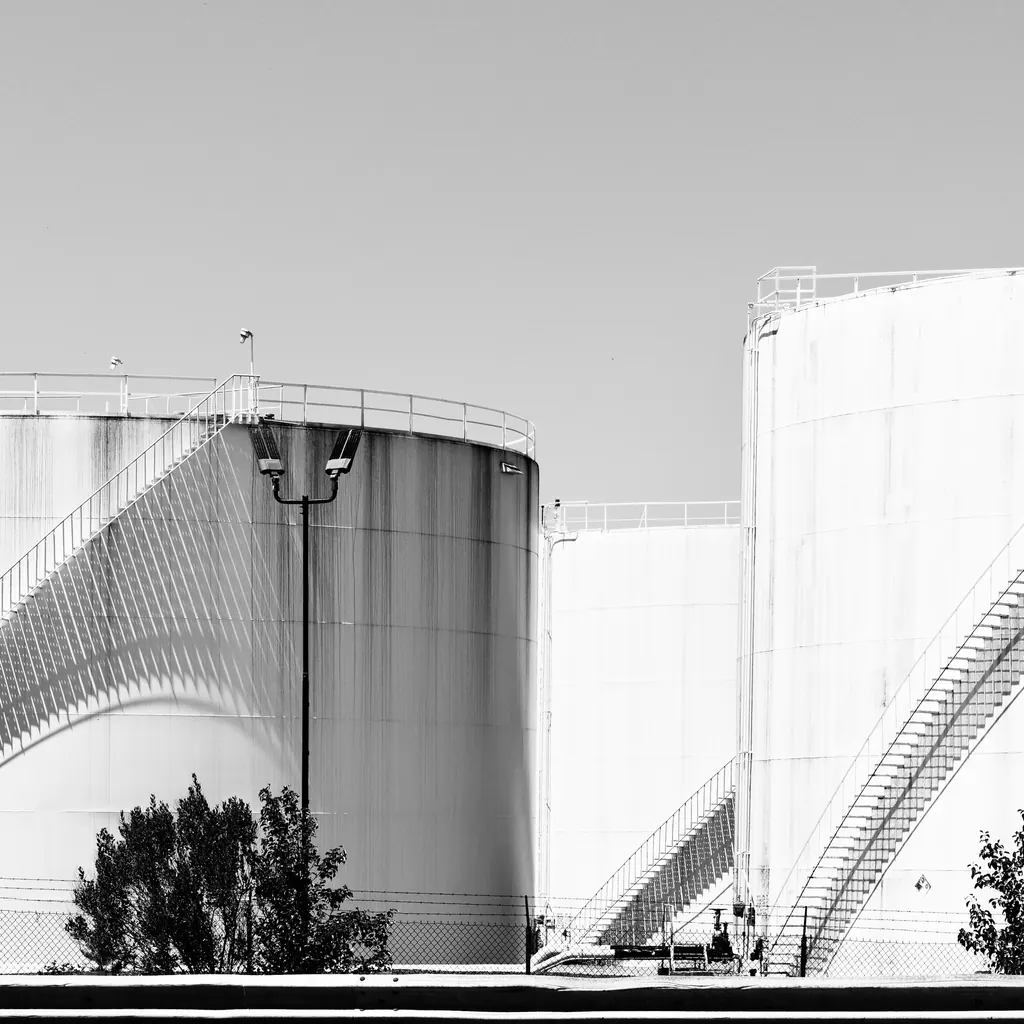
Black and white view of large steel storage tanks with spiral stairs

Our History

Our History: Nine Years of Deliberate Growth

We did not grow by chasing volume. We started with engineering and consulting, then set out a clear strategy and built the network one well-chosen terminal at a time.

Timeline

2017 to 2026

From a founding team of six in Kuala Lumpur to an integrated four-hub network.

  1. 2017

    Company Founded

    Incorporated in Malaysia on 24 January 2017. Asian Oil Storage is registered with Suruhanjaya Syarikat Malaysia to develop and operate oil and gas storage infrastructure. A founding team of six sets up in Kuala Lumpur and takes on its first consulting mandates: storage demand and site-screening studies for regional fuel distributors in Peninsular Malaysia.

  2. 2018

    Terminal Development Begins

    Ir. Tan Boon Hock joins as the first engineering hire, and the in-house engineering team is formed. The company completes its first major development assignment: pre-FEED for a 150,000 m³ coastal distribution terminal in Peninsular Malaysia for a regional distributor. The work covers tank farm layout, jetty concept and a Class 4 cost estimate.

  3. 2019

    Consulting Capability Expands

    The consulting practice delivers 12 studies in Malaysia, Indonesia and Vietnam, including a coastal fuel depot feasibility study in Sumatra and a product terminal concept study in central Vietnam. Lim Siew Ling joins as Chief Financial Officer. The team grows to 24 people.

  4. 2020

    The Four Corridors Strategy

    The Board approves the Four Corridors strategy: to own and operate independent storage at four global energy hubs, one on each of the main corridors linking Asia Pacific, the Middle East, Europe and North America. Daniel Wong Kah Leong joins as Chief Executive Officer to lead it. The company secures long-term institutional infrastructure investment, and Kavitha Subramaniam joins to build the group HSSE management system ahead of the first acquisition.

  5. 2021

    Asia Pacific Hub in Singapore

    Asian Oil Storage acquires an operating products terminal in the Jurong industrial area of Singapore, with 530,000 m³ in 11 tanks. It is renamed the AOS Jurong Energy Terminal. The first 100 days focus on HSSE alignment, a full inspection of tanks and marine assets, and retaining the experienced operations team.

  6. 2022

    European Hub in Rotterdam

    The company acquires a clean products terminal in Rotterdam’s Botlek area, with 700,000 m³ in 16 tanks and six barge berths. It becomes the AOS Rotterdam Botlek Terminal. In February, the Board takes the final investment decision on the Singapore Storage Expansion, which will add five tanks and 290,000 m³. Network capacity reaches 1.23 million m³.

  7. 2023

    Middle East Hub in Fujairah

    Asian Oil Storage acquires a crude and fuel oil terminal at the Port of Fujairah, with 800,000 m³ in 10 tanks and a VLCC-capable berth. It becomes the AOS Fujairah Marine Terminal. In September, the Singapore expansion is commissioned 19 months after FID, bringing Jurong to 820,000 m³. Work begins on the Rotterdam Energy Logistics Hub and Fujairah optimisation programmes. Network capacity reaches 2.32 million m³.

  8. 2024

    North American Hub in Houston

    The company acquires an operating terminal on the Houston Ship Channel with 640,000 m³ (about 4.0 million barrels) in 14 tanks, served by ship, barge, pipeline, truck and rail. It becomes the AOS Houston Ship Channel Terminal, completing the four-hub network. Planning and proposal briefings begin for the Borneo Oil Storage Terminal in East Malaysia. Network capacity reaches 2.96 million m³.

  9. 2025

    An Integrated Global Network

    All four terminals now run on one group terminal management system. The Network Performance Centre in Kuala Lumpur begins round-the-clock performance monitoring and analytics. Two 80,000 m³ tanks are commissioned in Fujairah and two 30,000 m³ biofuel tanks in Rotterdam, taking network capacity to 3.18 million m³ in 60 tanks. Throughput reaches 18 million tonnes. Preliminary infrastructure consulting for Borneo is completed, including site screening and the terminal masterplan concept.

  10. 2026

    Digital Infrastructure and Network Optimisation

    A digital twin pilot goes live at the Jurong terminal, and predictive maintenance is rolled out across critical rotating equipment. The Borneo Oil Storage Terminal moves into pre-FEED and environmental impact assessment scoping, and FEED begins on Phase 3 of the Fujairah expansion. The company sets out its 2030 targets: 35% lower emissions intensity and 60% renewable electricity.

Growth at a Glance

Capacity Built One Terminal at a Time

Capacity grew from 530,000 m³ in one terminal in 2021 to 3.18 million m³ across four terminals and 60 tanks at the end of 2025.

Network storage capacity, m³ (year end)Hover or focus a column for terminals and tanks.
0
1.0M
2.0M
3.0M
View as table
Network storage capacity by year
Year endTerminalsTanksCapacity (m³)
2021111530,000
20222271,230,000
20233422,320,000
20244562,960,000
20254603,180,000

What Comes Next

The Next Chapter

Our priorities to 2030 are clear:

01

Grow within the network.

We have expansion capacity at every hub: Fujairah Phase 3 (240,000 m³, now in FEED), Houston (160,000 m³, permitted), Rotterdam renewable fuels (120,000 m³, in permitting) and a Singapore brownfield expansion (100,000 m³, under study).
03

Decarbonise operations.

Meet our 2030 emissions intensity and renewable electricity targets.

04

Prepare for new molecules.

Design tanks and systems that can handle renewable fuels and lower-carbon products as demand grows.

Next steps

Be Part of What We Build Next

Talk to our commercial and engineering teams about storage, development or partnership.