
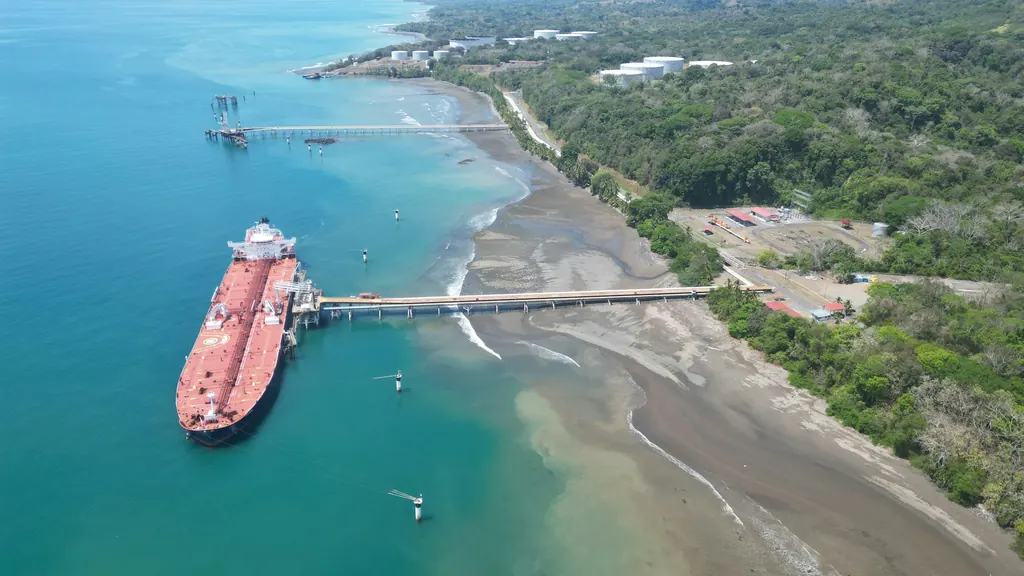
Aerial view of a tanker moored at a long jetty beside a forested tropical coastline

Flagship Project · East Malaysia

Borneo Oil Storage Terminal

A proposed deepwater storage and marine terminal designed to strengthen fuel supply security, cut logistics costs and support industrial growth across East Malaysia. Asian Oil Storage leads the project’s planning, proposal briefings and preliminary infrastructure consulting.

Planning stage: pre-FEED and environmental impact assessment scoping. All figures are planning estimates, subject to engineering, regulatory approval and investment decisions.

480,000 m³

Phase 1 storage capacity

840,000 m³

Masterplan capacity

20

Tanks at full build-out (12 in Phase 1)

42 ha

Site footprint

1.2 km

Jetty trestle to −15.0 m chart datum

80,000 DWT

Phase 1 deep-sea berth

~RM 1.4 billion

Phase 1 estimated investment

2030

Phase 1 commissioning target

Estimates at AACE Class 5 (concept screening) accuracy, typically −30% to +50%.

Project Overview

A Strategic Terminal for East Malaysia

The Borneo Oil Storage Terminal is a proposed bulk liquid storage and marine terminal on a deepwater coastal industrial site in East Malaysia. It is designed to receive refined products and marine fuels by deep-sea tanker, store and blend them, and distribute them by coastal tanker, barge, truck and, in future, pipeline to markets across Sabah, Sarawak and the wider region.

Asian Oil Storage’s role to date covers planning, proposal briefings and preliminary infrastructure consulting. The work has run from site screening and concept development to the terminal masterplan, marine interface concept and a phased development programme. It draws on our infrastructure consulting and terminal planning practices.

The masterplan provides 840,000 m³ in 20 tanks, developed in two phases:

Phase 1

480,000 m³

12 tanks, one deep-sea berth and two coastal and barge berths

Phase 2

+360,000 m³

A further 8 tanks and a second deep-sea berth, to be built as demand grows

Background

Why East Malaysia Needs New Storage

East Malaysia covers a large area with long coastlines, dispersed population centres and a growing industrial base. Much of its fuel supply still depends on:

Small, ageing coastal depots with limited tankage, often unable to take economically sized cargoes

Long supply chains that rely on frequent small-parcel deliveries by coastal tanker

Limited buffer stocks, which leave supply exposed to weather, shipping disruption and refinery outages

Growing demand from industry, transport, aviation and marine activity

A modern, deepwater terminal of sufficient scale can take larger, more economic cargoes, hold strategic buffer stocks and act as a distribution hub for the smaller depots across the region.

Strategic Objectives

What the Terminal Is Designed to Achieve

  1. 01

    Strengthen supply security

    Provide buffer storage that protects East Malaysian fuel supply against shipping and refinery disruptions.

  2. 02

    Reduce logistics costs

    Replace frequent small-parcel deliveries with fewer, larger deep-sea cargoes, cutting the cost per tonne delivered.

  3. 03

    Support regional development

    Provide a fuel supply base for industrial parks, ports, airports and marine activity.

  4. 04

    Enable cleaner fuels

    Provide dedicated capacity for biodiesel (FAME) blending in line with Malaysia’s biodiesel programme, and design flexibility for future lower-carbon fuels.

  5. 05

    Build local capability

    Create construction and permanent jobs, and train a local technical and operational workforce.

  6. 06

    Serve marine fuel demand

    Supply VLSFO and marine gasoil to vessels operating in regional waters.

Terminal Masterplan

A Phased, Expandable Layout

The 42-hectare site is planned in functional zones.

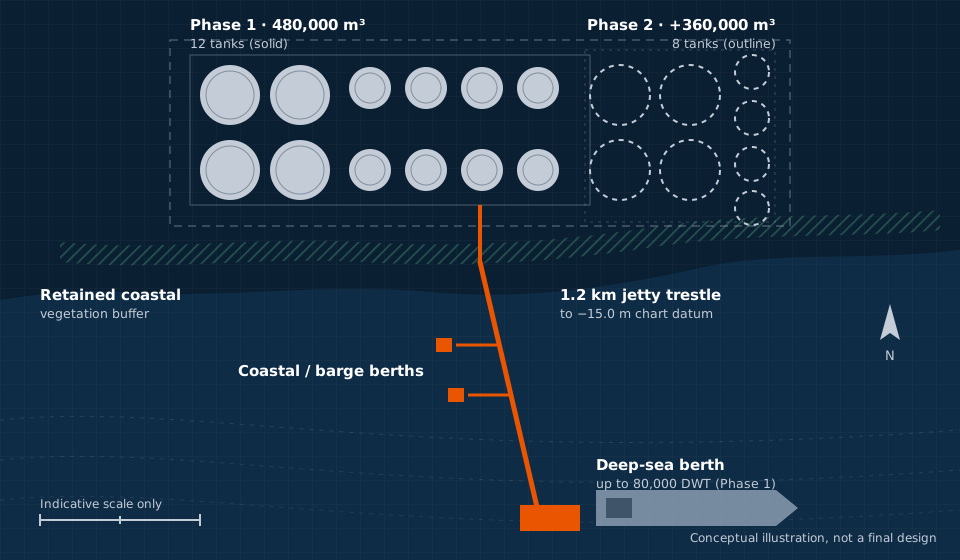
Conceptual masterplan: Phase 1 tank group of 12 tanks, Phase 2 reserved plot of 8 tanks, a 1.2 km jetty trestle to a deep-sea berth, two coastal and barge berths and a retained vegetation buffer
Phase 1 tanks shown solid, Phase 2 in outline.
Masterplan zones
ZoneContentsPhase
Tank farm A12 tanks in bunded groupsPhase 1
Tank farm B8 tanks, reserved plotPhase 2
Process and utilitiesPump stations, blending skids, firewater pumps and storage, nitrogen, power substation, wastewater treatmentPhase 1, sized for Phase 2
Loading4-bay truck loading rack, with space for 4 more baysPhase 1 / 2
MarineJetty trestle, deep-sea berth, 2 coastal/barge berths; second deep-sea berthPhase 1 / 2
Administration and controlControl building, laboratory, workshops, warehouse, emergency response stationPhase 1
Buffer and environmentRetained vegetation buffer, drainage retention ponds, landscape screeningPhase 1

Masterplan Principles

  • Separation by design: Tank groups, process areas and occupied buildings are laid out using fire and explosion consequence modelling, with occupied buildings placed upwind of the prevailing wind
  • Build once, expand cleanly: Main pipe racks, firewater mains and electrical infrastructure are sized for full build-out, so Phase 2 can connect without shutting down Phase 1
  • Two-way emergency access: Emergency vehicle access to every tank group from at least two directions
  • Drainage and containment: Bunds sized for the largest tank plus firefighting water allowance; clean and oily water drainage kept separate; retention ponds before discharge

Storage Infrastructure

Storage Facilities

Planned storage facilities by phase
PhaseTanksCapacity eachTotalIndicative service
Phase 1460,000 m³240,000 m³Diesel / gasoil, VLSFO (heated)
Phase 1830,000 m³240,000 m³Gasoline, jet fuel, marine gasoil, FAME
Phase 1 total12480,000 m³
Phase 2460,000 m³240,000 m³Allocated according to demand
Phase 2430,000 m³120,000 m³Allocated according to demand
Phase 2 total8360,000 m³
Masterplan total20840,000 m³
  • Internal floating roofs on gasoline and jet fuel tanks to reduce evaporation losses and emissions
  • Heated, insulated tanks for VLSFO
  • Dedicated FAME storage with inline blending into diesel at the truck rack and marine loading
  • API 650 design, with double bottoms and leak detection on all tanks
  • Automated tank gauging with independent overfill protection on every tank

Marine Facilities

Marine Interface

The site was chosen partly because deep water lies relatively close to shore. That keeps the jetty trestle to about 1.2 km and avoids major capital dredging.

Marine facilities by phase
ElementPhase 1Phase 2
Jetty trestle1.2 km to −15.0 m chart datum-
Deep-sea berth1 berth, up to 80,000 DWTSecond berth, up to 120,000 DWT
Coastal / barge berths2 berths, 1,500–10,000 DWT-
Loading arms12-inch and 16-inch with emergency releaseAdditional arms for Berth 2
Typical loading rate2,500 m³/h at deep-sea berth3,500 m³/h at Berth 2

Design Considerations

  • Metocean conditions: Monsoon-season wind and wave data set mooring design and operating windows
  • Mooring analysis: Dynamic mooring studies for the design vessels
  • Spill response: Oil spill response equipment at the jetty head, with booms pre-positioned for sensitive shoreline areas
  • Navigation: Approach channel, turning area and aids to navigation to be agreed with the port and marine authorities

Pipeline Infrastructure

Phase 1 includes about 6.5 km of transfer pipelines:

  • Jetty lines along the 1.2 km trestle, with dedicated lines for clean products, jet fuel and VLSFO
  • In-terminal transfer lines connecting tank groups, manifolds, the blending skid and the truck rack
  • Pigging facilities on the main jetty lines to reduce product interface losses

Future connectivity: An interconnection corridor of up to 18 km to regional industrial users is being studied, subject to demand and approvals.

Engineering

Engineering Approach

The preliminary engineering has set the project’s design basis.

Engineering design basis
DisciplineKey considerations
GeotechnicalCoastal soils assessed through desktop study and initial borehole data. Tank foundations likely to need ground improvement or piling, to be confirmed through a full site investigation
CivilSite levelled above the design flood level with climate change allowance; surface-water drainage designed for tropical rainfall intensity
MechanicalTanks to API 650; pumps sized for Phase 2 flow rates where economic
ElectricalGrid connection with backup generation for critical loads; rooftop and ground-mounted solar planned for the administration and warehouse buildings
Instrumentation and controlSCADA and terminal management system aligned with the group platform; safety instrumented systems to IEC 61511
Fire protectionFixed foam systems, firewater network, monitors, and a firewater reservoir sized for the worst-case fire scenario
Process safetyHAZID completed at concept stage; HAZOP and LOPA to follow in FEED
Aerial view of a forested tropical coastline with clear water and a jetty

Environmental Considerations

Designing With the Environment

Borneo’s coasts are ecologically important. Environmental considerations have shaped site selection and the masterplan from the start.

  • Site selection: Of the three sites screened, the preferred site was chosen partly because it is on land already zoned for industry and avoids primary mangrove and sensitive coral areas
  • Environmental impact assessment: EIA scoping is under way, covering marine ecology, coastal processes, air quality, noise, water quality, traffic and social impacts
  • Vegetation buffer: A retained vegetation buffer along the shoreline and site boundaries
  • Jetty trestle: An open-piled design keeps coastal water flowing and reduces seabed disturbance compared with a solid causeway
  • Emissions control: Internal floating roofs, vapour control at the loading points, and energy-efficient pumps and lighting
  • Spill prevention: Double tank bottoms with leak detection, bunded tank groups, and spill response equipment at the jetty
  • Water management: Oily water separation and treatment before discharge; rainwater harvesting for non-potable uses
Our approach to sustainable terminal development

Development Phases

Project Timeline

  1. 2024

    Planning and proposal briefings

    Opportunity framing, early stakeholder engagement, 14 proposal briefings over 2024–2025

    Completed

  2. 2024–2025

    Preliminary infrastructure consulting

    Site screening (3 sites), demand assessment, concept development, terminal masterplan, marine concept, Class 5 estimate

    Completed

  3. 2026

    Pre-FEED and EIA scoping

    Design basis, site investigation planning, EIA terms of reference, refined estimate

    Current stage

  4. 2027 (target)

    FEED and approvals

    Front-end engineering design, EIA submission, permits, procurement strategy

    Planned

  5. 2028 (target)

    Final investment decision

    Financing, contracting, investment decision

    Planned

  6. 2028–2030 (target)

    Phase 1 construction

    Site preparation, tank construction, jetty, utilities

    Planned

  7. 2030 (target)

    Phase 1 commissioning

    Commissioning, start-up, operational readiness

    Planned

  8. From 2032, subject to demand

    Phase 2

    Additional 360,000 m³ and second deep-sea berth

    Future

Investment Outline

AACE Class 5 estimates. Final figures will depend on site investigation, FEED and market conditions.

Investment outline
ScopeEstimated investment
Phase 1 (480,000 m³, jetty and utilities)Approx. RM 1.4 billion
Phase 2 (360,000 m³ and second berth)Approx. RM 0.9 billion
Programme totalApprox. RM 2.3 billion

Asian Oil Storage’s Role

What We Have Done

Asian Oil Storage has led three streams of work:

1

Planning

  • Framed the project objectives and development strategy
  • Screened three candidate sites against marine access, land, environmental sensitivity, connectivity and community factors
  • Assessed demand across fuel grades and end-user segments
  • Developed the phased development plan
2

Proposal briefings

  • Prepared and delivered 14 proposal briefings to potential partners, government agencies, industrial users and financial institutions
  • Produced the project briefing pack, including concept design, phasing, indicative economics and implementation approach
3

Preliminary infrastructure consulting

  • Developed the terminal masterplan and zoning
  • Defined tank configuration and product allocation
  • Prepared the marine interface concept, including jetty trestle routing and berth configuration
  • Set out the pipeline and utilities concept
  • Prepared the Class 5 cost estimate and the preliminary schedule
  • Completed the concept-stage HAZID

Why It Matters

Our engineering team in Kuala Lumpur is doing this work alongside the operations and technical specialists who run our four international terminals. What we have learned from operating in Singapore, Rotterdam, Houston and Fujairah feeds directly into the design of a terminal in Borneo, which will also connect with our Singapore hub.

Expected Regional Impact

Benefits for East Malaysia

The estimates below come from preliminary studies and will be refined through the EIA and social impact assessment.

~1,100

Jobs at peak construction

~85

Permanent operating roles in Phase 1

Expected regional impact
AreaExpected impact
Supply securityBuffer storage equal to several weeks of regional demand for key fuel grades
Logistics efficiencyEconomically sized deep-sea cargoes, lower delivery costs and fewer coastal tanker movements
EmploymentAbout 1,100 jobs at peak construction; about 85 permanent operating roles in Phase 1
Local supply chainContracting opportunities for local civil works, fabrication, services and logistics
SkillsOperator and technician training programmes, with priority for local candidates
Industrial developmentFuel supply base for industrial parks, ports and power generation
Cleaner fuelsBiodiesel blending capacity and flexibility for future lower-carbon fuels

Future Expansion

Beyond Phase 2

The masterplan is designed to keep future options open:

  • Pipeline interconnection to regional industrial users (up to 18 km corridor under study)
  • Lower-carbon fuels: Tank and line designs that can be converted to renewable diesel, SAF or other lower-carbon liquid fuels as demand develops
  • Marine fuels hub: Additional bunker barge capacity if regional marine fuel demand grows
  • Integration with the Asian Oil Storage network: Coordinated supply with our Singapore hub, which is about two to three days’ sailing away

Next steps

Partner With Us in Borneo

We welcome conversations with potential partners, offtakers, industrial users, financial institutions and government stakeholders interested in the Borneo Oil Storage Terminal.